Mini Monets and Mommies

Friday, July 17, 2015

Frozen Glitter Ice Paint for Kids

Does child adore Elsa? Is he over-the-top for Olaf? Then this Frozen kids’ activity is for him. Yes, it’s ‘Frozen’ like the Disney movie, but it’s also freezing too.

Science kids

Maybe it’s the summer heat or maybe it’s just a desire to use my new set of ice cube trays, but I’ve been doing icy exploration after icy exploration – ice building blocks, experiments, freezing chalk paint and now sparkling, glitter Frozen water colors!

This kids’ activity combines art and science. Sure, it’s got gaggles of glitter. But, it also includes a bit of exploration and discovery. You can make the Frozen ice cubes one of two ways – use food coloring or go with tissue paper. If you’re asking what tissue paper has to do with making icy blue sparkle cubes, keep reading to find out. It’s a really cool (I’d say no pun intended, but it was just too good to pass up) project.

Before you get started ask your child to predict what will happen when you freeze the colorful water. Ask if he thinks the glitter will freeze too. After the exploration is over, talk about your child’s predictions. Remind him of what he said and have him compare that to what really happened.
Water colors

Here’s What You’ll Need:

·        An ice cube tray

·        Blue tissue paper – Do not use color-fast paper. It won’t work for this activity.

·        A straw or paintbrush

·        Blue food coloring

·        Blue glitter

·        Water

·        Card stock paper

Here’s What to Do:

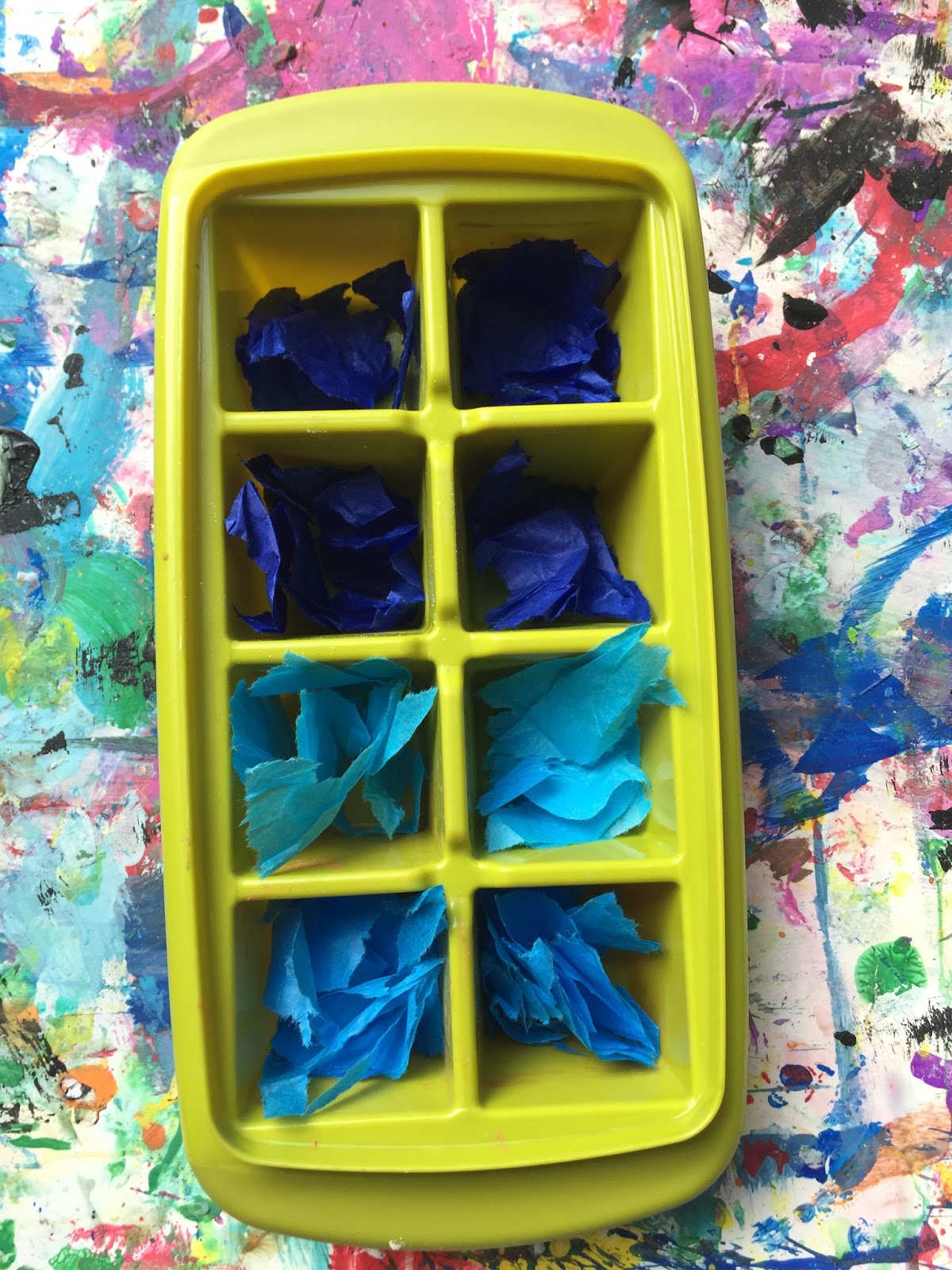
1.     Tear up the tissue paper into pieces. Try a few different shades of blue to see what happens.
Kids' art

2.     Put the tissue into the ice cube tray.
 
Paper art

3.     Fill each compartment with water.
 
Science activity

4.     Let the tissue color bleed into the water, stirring periodically with a straw or paintbrush. Your child can compare the different shades of blue to see if they look different. Our lighter blue didn’t work at all – sometimes these things just don’t come out like you think they will. But, the deep blue did work well.
 
Art activity

5.     Fill any remaining compartments (or use another tray) with water and a few drops of blue food coloring.
 
Frozen art

6.     Stir the food coloring.

7.     Sprinkle glitter across the top, covering the water completely.
 
Sparkle activity

8.     Put the colorful sparkle cubes into the freezer.

9.     Pop the frozen cubes out when they are ready.

10.   Paint with the blue glitter water colors on the card stock paper.
 
Ice Science

11.   Optional: Add a layer of school glue (your child can paint it on) first. This gives the glitter something to stick to.

When your child is finished painting with the ice, ask him about the liquid to solid to liquid transformation that just happened. Talk about the water and why it turned into ice. Have your child explain (in his own words) what happened to make the ice turn back into water again. You can also discuss the tissue paper and why the color came off of it. Instead of telling your child, let him tell you!
Glitter project

Are you looking for more science and art activities? Follow my Pinterest board for ideas from around the Internet!
Follow Mini Monets and Mommies's board Preschool Art and Science Activities on Pinterest.

Monday, July 13, 2015

10 Reasons Not to Write for a Content Mill

So, you want to be a freelance writer? You’ve heard that content mills are the place to begin, and are wondering what they’re all about. If you want to write online (is there really anywhere else to write these days?), content mills are totally tempting.


Freelance writer


Shortly after I started freelancing a fellow writer told me about this website that had thousands of article titles to choose from, paid every few days and was guaranteed work whenever I wanted it. I jumped at the chance. That was in 2009. Fast-forward six years and I’ve moved on. As a recently reformed content mill junkie, I’m going to share my thoughts on why this is NOT the place to create your career.

1.     The pay sucks -- seriously. When I started, I was writing $7.50 articles. Eventually I was making $25 an article. But, in the grand scheme of the online writing world that really isn’t a decent wage. Private clients will pay you more. How much more? It depends. It could be $50, or it might be $500. I have blogging friends who won’t write a guest post or a sponsored post for less than $150. So, why on Earth is it ok to pay someone $7.50 for the same amount of work?

2.     There’s no negotiation. I’m a terrible negotiator. That said, I’ve managed to get a fair price from almost all of my clients through the process. With content mills the pay is standard across the board. You accept it, or you don’t.

3.     It’s boring. My topic of choice is ‘kids’ art activities’. Second to this is ‘parenting’. I actually started my blog out of frustration brought upon by not being able to write about what I truly loved. If you don’t particularly mind writing a dozen articles about emergency dental procedures one day, decorating tips for middle-aged men the next and fascinating facts about oak trees after that, content mills might be a perfect match. On the other hand, if you want to use your professional or educational background, don’t do it.
 
Working writer

4.     It’s kind of weird. Some mills use a computer-generated titling or keyword selection tool. This makes the content somewhat off. I’ve written stupendously stupid titles such as, “Places to Hang My Purse” (um, if you can’t figure this one out on your own, you’re probably not smart enough to google it either) and, “Is It a Beaver in My Backyard?” (maybe, I mean if it looks like one). Some companies won’t give you titles. Instead, they give you keywords to work with. These too can be odd, and while they do make sense as search terms they don’t flow naturally. For example, “outdoor activities summer kids”. What am I going to do with that?

5.     You’ll get lazy. Complacency is not a good thing, especially when you’re a budding freelancer. You’ve got to get out there and really sell yourself. No one will hustle for you, and if you’re not hustling you’re not getting any work. I had steady work through a content mill giant for a few years. I had enough work that my student loans went from an economic hardship deferment to the income-based repayment plan to full repayment. In other words, I was making a pretty great full-time income while I was sitting on my couch, watching the Real Housewives of some place or another and writing about purses and beavers (among many other things). I completely stopped looking for clients and tossed out the idea of starting my own blog. Why mess with a good thing, right? Nope, na-ha, now way, couldn’t be more wrong. When the mill fell apart, many of us lost some serious work. I went from a steady income to nothing. After years of what I know realize was wasting time, I had to start over and build a client base.

6.     The cookie cutter-ness of it will make you crazy, stupid or both. I got so used to writing in one format, with one style that I forgot to be original and use my own voice.

7.     Rushing work will become the norm. I have blogger buddies who spend hours on one post. Had I done that while working for content mills I would have made almost nothing. At my work-load height I was writing between eight and ten 600+ word articles per day.

8.     Real publications might not respect your work. When I submit online writing samples to potential clients I never, ever use my mill work (some of it is published under my name, while others were ones that I had ghost-written).

9.     There’s no real client-freelancer relationship. I enjoy the online interactions that I have with my private clients. I like the friendly emails and sometimes we even talk via phone or FaceTime. On the flip side, unless you’re emailing the tech department of the content-producing site because your editing window refuses to accept changes or you can’t log into your account, you may as well be working for the same computer program that’s picking those weirdo titles.

10.   You want a career. Content mills rise and fall. They overflow with an abundance of work for thousands of writers, and then abruptly shut down. Instead of putting your faith and talents into one of these sweatshops for writers, put it in yourself. Build your skill, confidence and brand – and contribute to your own success!


Sunday, July 12, 2015

Melting Ice Kids' Science and Water Color Activity

Sometimes in the summer I just can’t stop it with the ice activities. It’s hot out, anything frozen melts easily and I tend to go a bit overboard. What frozen kids’ activities (the activities were kept chill, not the kids) have we been up to lately?

Art for kids

I’ve done icy building blocks, frozen chalk paint cubes, a rainbow race and now it’s time for timing how fast ice melts in different types of light (and it also doubles as a water color art exploration). This is super-simple, and combines science and art.

Before you begin start with a few questions. Ask your child to predict how fast he thinks the ice will melt. He can give you a specific time (such as 10 minutes) or use his own terms (all afternoon, until bedtime, etc.). Discuss why your child thinks the ice changes from a solid to a liquid and if it can go backwards.

Some vocabulary words to include are:

·        Solid

·        Liquid

·        Prediction

·        Ice

·        Data

What You’ll Need:

·        An ice cube tray

·        Food coloring

·        Water

·        White card stock paper

·        Timer – You can use your cell phone’s timer.

·        Paper – Other than card stock (you can use notebook paper or pieces of scrap).

·        A pencil

What to Do:

1.     Drip one or two drops of food coloring into each compartment of the ice cube tray. Use a few different hues.

2.     Add water. Stir the color and the water together.

3.     Freeze the cubes.

4.     Set up at least two (I used three, but you can create more) experimentation stations. Place the card stock inside and outside. Indoors, your child can pick a sunny window sill spot, a shaded table or another area. Outside, he can try an open light-filled area, under a tree or an in-between space.

5.     Take the cubes out of the freezer.
 
Frozen paints

6.     Put at least two pieces of ice on each piece of paper.
Kids' activities

Kids' art

7.     Note the time for each ice placement. Write the time on a separate piece of paper.

8.     Time how long it takes each ice station to start melting. Wait until your child sees the water colors running out onto the paper. Note the times.
 
Ice art

9.     Paint with the melting cubes. Your child can push them around the paper, tilt the paper around or experiment with the process.

Art Ice

10.  Compare the melt times. Ask your child to look at the data (i.e., the times that you wrote down). Which one took the longest to melt? Which one was the quickest? Why?

You can use a piece of poster board and markers or crayons to write out the time differences. Have your child point to the biggest numbers and the smallest.

Are you looking for more science and art activities? Follow my Pinterest board for ideas!
Follow Mini Monets and Mommies's board Preschool Art and Science Activities on Pinterest.

Friday, July 10, 2015

Oreo-Bottom Dirt Cupcakes

Who doesn’t like an Oreo-bottom chocolate cupcake? Ok, so if you’re nixing sugar, are going paleo or are otherwise on a healthy eating kick this really, really, really, REALLY isn’t for you. But, if you’re up for a tasty treat or have a party to plan (these cute cakes are perfect for summer picnics or backyard kids’ birthday bashes), give them a try!

Dirt Dessert

I’m not the best baker. That said, even I can make an Oreo-bottom cupcake. They really take very little skill, and as a bonus the kids can pitch in and help to cook. I’ve made these little goodies before. This time I’m going with a dirt theme. Not that you, your child or party guests are begging to eat dirt, but it’s a fun way to dress up a cupcake (and it adds even more chocolate).
Dessert recipes

Here’s What You’ll Need:

·        Chocolate cake mix – If you’ve got a favorite recipe, feel free to use it. If you’re challenged in the baking area (like I am), there’s no shame in using a boxed mix. That’s what it’s there for.

·        White frosting – Again, use your own recipe or try the pre-packaged stuff. I used a vanilla-marshmallow flavor.

·        Oreos

·        Cupcake tins with liners

Here’s What to Do:

1.     Mix the cake batter.

2.     Place one Oreo at the bottom of each lined cupcake pan compartment.

3.     Pour the batter over the cookies.

4.     Bake the cupcakes.

5.     Crush the rest of the Oreos. Use a blender or food processor to turn the cookies into a sand-like consistency.

6.     Take the cupcakes out of the oven (after they are completely baked), and let them cool.

7.     Frost the cakes.

8.     Sprinkle the cookie crumbles on top.

The cookies on top of the cupcakes will look like dirt! You can also add a few gummy worms or chocolate syrup (it looks like mud), for effect.
Dirt dessert

Are you looking for more cupcake recipes? Follow my Pinterest board for ideas!
Follow Mini Monets and Mommies's board Cupcakes! Yum! on Pinterest.

Monday, July 6, 2015

Learn with Play: 150+ Ideas for Year-round Fun & Learning Book Release!

I’m super-excited to announce the release of the new book Learn with Play: 150+ Ideas for Year-round Fun & Learning. Ok, so I’ am included in the book. But, it’s filled with more than 150 (obviously, based on the title) ideas, activities, projects, lessons, crafts and artsy adventures by some of the best bloggers out there.

Kids' activities
 
(This post contains affiliate links. Please see my disclosure statement for more information).
Seriously. The 94 co-authors from the Kid Blogger Network are all imaginatively awesome when it comes to creating kids’ activities. I’m pretty picky when it comes to big books like this. Between having my own child, teaching preschool-aged kids and teaching art classes, I’ve browsed quite a few crafty compilations. This one takes the cake. The ideas intelligent, creative and pure fun!


Hands-on ideas


What will you find in Learn with Play: 150+ Ideas for Year-round Fun & Learning? All kinds of cool stuff! It includes sensory play, fine motor, arts and crafts, holiday projects, science, math, literacy, life skills, imaginative play and even area organization.
Year-round fun


Why get this book? I know, I know. There are enough kids’ activities books out there to fill every bookshelf in your home. But, this one is special. The bloggers who co-authored it comes from a variety of backgrounds (and from all over the world), all adding their unique skill sets to the ideas. The activities are all hands-on, with detailed how-to steps and materials lists. The activities also bridge a wide range of ages. You’ll find ideas for babies, toddlers, preschoolers and kindergarten kids!

Where can you get it? You can get a regular old-fashioned print copy, a Kindle edition or choose the ebook version. If you’re going with the ebook, during the first week of the release we’re offering a $5 discount, making it $9.95 (starting July 7, 2015).

The regular prices are as follows:

·        Print copies are available from Amazon for $29.95.

·        The Kindle edition is also available on Amazon and is $14.95.

·        The ebook’s regular price is $14.95 (this is the price after the initial launch week).

 
Activities resource

Saturday, July 4, 2015

Science and Art: Red, White and Blue Frozen Chalk Paint

Frozen chalk, what is it and why? It seems fairly straightforward – frozen pieces of chalk, right? How would that work? Let me tell you. Not well. But, when you make frozen chalk ice cubes it becomes a water color paint.

Chalk art

Combine science and art into one activity! We’ve made frozen chalk before. So, this time it has a red, white and blue theme. Try this for any patriotic holiday (such as July 4th or Memorial Day) or use it as a color-mixing exploration.

The Science Part

Your child is observing physical properties all of the time, whether he realizes it or not (chances are – not). This science exploration lets him discover how liquids change into solids and then back to liquids again during the freezing and unfreezing process. It also adds in the chalk, which makes it somewhat different that the typical ice experiment.
Science art

Before you get started, ask your child a few questions such as:

·        Is the stick of chalk a solid, liquid or gas?

·        When we smoosh the chalk what will it turn into?

·        What will happen when we add water to the chalk and put it in the freezer?

·        How do you think we are going to be able to turn the chalk into water color paints?

After making a few predictions about what will happen it’s time for …

The Art Part

Ok, so really this is art and science together.

Here’s What You’ll Need:

·        Red, white and blue chalk—Your child can also try this with other colors or just use the primaries (red, yellow and blue) for a complete color-mixing activity.

·        Water

·        An ice cube tray

·        Card stock paper – I prefer to use a heavier weight paper, as it holds the chalk water colors better.

Here’s What to Do:

1.     Crush the chalk. There are several different ways to do this. We like putting the chalk into a baggie and smashing it with the back of a large wooden spoon. I’ve also found that this works best when the chalk is warm (heat it in the sun) first. But, you child can figure out other ways to smash it (dropping it on the ground, throwing it on the patio or using another tool to break it apart).
 
Science art

2.     Add a tablespoon or so of chalk to each compartment of the ice cube tray.
 
Ice tray

3.     Pour water in on top of the chalk.
 
Colorful art

4.     Put the tray into the freezer for a few hours (or overnight).

5.     Pop the frozen cubes out.
 
Ice cubes

6.     Move them around the paper. As they melt, the colors will begin to mix. Ask your child what the red and blue are making (i.e., purple). Also have your child observe what the white chalk paint does to the darker colors (it makes them lighter).
 
Patriotic art

Are you looking for more kids’ art and science activities? Follow my Pinterest board for ideas!


Follow Mini Monets and Mommies's board Preschool Art and Science Activities on Pinterest.